Oblique Seville is one of the smallest professional sprinters in the world. The 5-foot-6 Jamaican track and field athlete specializes in the 100 meters and is often the shortest and slightest lane assignment among much mightier competition. What Seville lacks in stature and brawn, he makes up for in precision and prowess. His underdog status easily makes him a fan favorite. But Seville isn’t a household name — not yet, anyway.
With an early athletic career defined by fourth-place finishes, he has struggled to advance to final rounds and earn medals that open doors to greater recognition. Perhaps one of the most disappointing examples was at the 2023 World Athletics Championships, a major steppingstone for runners on their way to the Olympics.
After advancing to the 100-meter final by winning his preliminary heat with a personal best, Seville was the fourth person to cross the finish line, missing the chance to gain ranking points needed for Olympic qualification by a hair. In a matter of milliseconds, his bronze-medal potential was swapped for an insignificant placing.
Alfalfa also has a track record of fourth place, often ranking as the fourth-most valuable field crop in the United States behind corn, soybeans, and wheat. Unlike the sport of sprinting, though, a fourth-place finish doesn’t reduce alfalfa’s importance as an agronomic pillar and a significant contributor to our nation’s economy, with an estimated $8.1 billion in 2024 farm gate sales.
A staple component of dairy and beef production, alfalfa also generates millions of dollars in export sales. It is heralded as the ultimate regenerative crop. And yet, alfalfa growers have limited options to offset losses when low hay prices and production pressures like rising input costs, dwindling livestock demand, and volatile growing conditions cause margins to shrink.
American Farm Bureau Federation economist Daniel Munch recently summarized alfalfa’s disadvantaged position in the article, “Alfalfa in the red: rising costs, falling returns.” Munch writes that alfalfa hay production is essentially an unbalanced equation with market prices that are far below full economic costs, heavily outweighed by fuel, fertilizer, labor, and machinery expenses. Even so, alfalfa has long been overlooked by policy support, including the new Farm Bridge Assistance Program.
Without standardized price discovery protocols, alfalfa can’t be covered by price- or revenue-based crop insurance policies. The indemnity payments and drought-relief programs that alfalfa does qualify for largely appeal to livestock producers who run short on feed — not the commercial hay grower whose primary income gets slashed by drought-induced production losses.
Alfalfa has characteristics that make it hard to compete with annual crops sold on the commodity market. It’s perennial lifespan limits producers’ ability to respond to market signals. In his article, Munch notes that when hay prices rise, new seedings can only comprise so many available acres. Even then, it takes a year or two for stands to reach their productive potential.
When prices fall, farmers are locked into a continuous cycle of cutting, drying, and baling hay for multiple years despite deteriorating returns. From 2000 to 2025, the national alfalfa acreage has slid from 23 million to 14 million acres, which Munch suggests is partly due to competition from field crops that are eligible for commodity safety net programs.
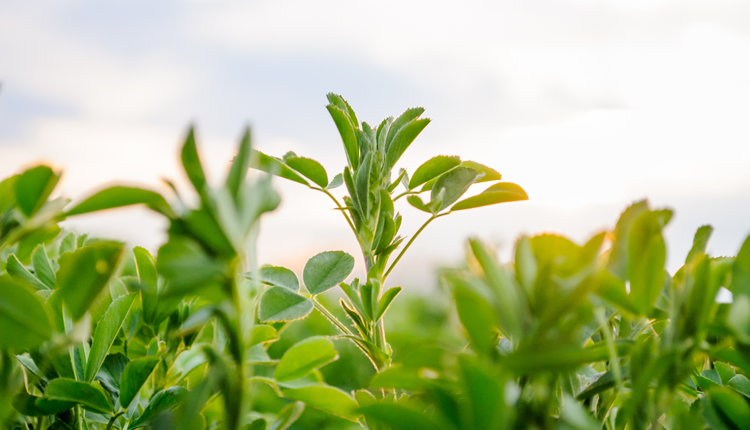
Some of the same characteristics that create challenges for alfalfa draw positive attention to it, though. Perennial root systems build soil organic matter and improve water infiltration. Continuous ground cover prevents erosion and runoff, while alfalfa’s ability to fix atmospheric nitrogen can benefit yields and reduce fertilizer costs for subsequent rotation crops. As Munch says, alfalfa’s overall role in United States agriculture is foundational. But without more responsive risk management tools and timely assistance, negative margins could accelerate the decline of the alfalfa industry’s resilience.
The 2023 World Athletics Championships was the last time Oblique Seville finished a race in fourth place. He persisted. He made it to the 2024 Olympics. And he recently won gold at the 2025 World Athletics Championships. Perhaps with similar perseverance and targeted advocacy, alfalfa will one day have a similar redemption story. That’s what needs to happen for alfalfa farmers to secure a more stable position in the broader agricultural market system.
This article appeared in the February 2026 issue of Hay & Forage Grower on page 4.
Not a subscriber? Click to get the print magazine.