Tracking Teff

Growers like this annual grass, but it needs a firm seedbed

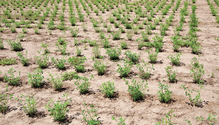
Even so, Winsett says, some of those “failures” did come up. “They got a little rain and teff was slow coming out of the ground because the seedbed wasn't firm. But once the grass did come up, it produced.”

University of Kentucky forage specialist Garry Lacefield has seen several fields of teff over the past two years with a range of successes.

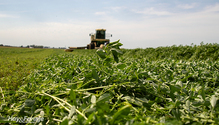
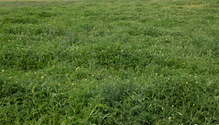
Besides reduced stands, some failures resulting from seeding techniques and competition from warm-season grassy weeds, he saw lodging on stands not cut early enough. Once seed heads emerge, there is potential for lodging. Several producers experienced poor regrowth when they cut teff too short.? “In other situations, excellent stands were obtained by hay producers happy with the crop,” Lacefield says.

Keith Callaway at Rainier Seeds, Pasco, WA, says growers in his area didn't have much luck with teff. But it's not the fault of the grass, he maintains.

“The growers didn't really understand how to grow teff, they put it in way too late and didn't give it the opportunity to develop like it should,” Callaway says.

Growers in Firstline Seeds' Moses Lake, WA, area, however, are replacing some timothy and orchardgrass acres with teff, believes Kirk Jungers, the seed company's president and owner.

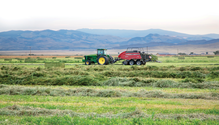
“We did thousands of acres last year where we overseeded timothy fields with Pharaoh after first cuttings,” says Jungers. “We take off first-cutting timothy about June 15, and June and July are so hot that the timothy doesn't do very well. So we overseeded teff into it and brought our production back to where it was for first cutting.”

His growers air-seed teff at 3-5 lbs/acre after timothy harvest but before irrigation is turned on.

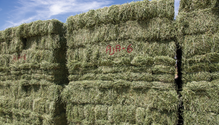
“It's made the most beautiful hay you've ever seen in your life,” he says. “It has a better feed value than timothy. It's about 10-15 points higher in RFV and the feed stores like it.”

Much of the teff goes to feed stores that sell to horse, llama and alpaca owners.

The end of last May, Virginia grower Mark Ferguson decided to no-till broadcast teff into fields that had been producing disappointing single-cut harvests of orchardgrass the past few droughty years.

Ferguson, of Sugar Loaf Farm, Staunton, took three teff cuttings that produced only 1 ton/acre. He figures he shouldn't have broadcast the teff seed, that he planted it two weeks too late and didn't apply nitrogen after planting.

He fed 50 lbs/acre of nitrogen for second and third crops, however. The number of small square bales produced from the 17.5 acres went from 112 from first cutting to 170 for second crop to a whopping 583 from the third cutting.

“So we're going to try some different things for the 2009 season to see if we can increase our tons/acre,” says Ferguson, who markets to horse and alpaca owners. He'll add nitrogen, work the soil and plant the second week of May.

Quality-wise, the teff cut at boot stage showed 14.9% crude protein and an RFV of 101. “I'm used to seeing an RFV for orchardgrass of around 71 or 80,” he says.

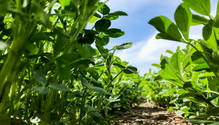
In droughty conditions, the teff showed growth but was stunted, Ferguson says. A rain after two to three weeks without water brought the grass from ankle to knee height within four days. “I'm amazed that, when it does get the moisture it needs, it grows very rapidly.”

South Carolina growers have also been struggling with drought the past few years, says Luther Wannamaker of Wannamaker Seed, St. Matthews. “So we were interested in something that would withstand drought, and teff works fine.”

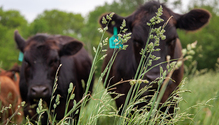
It's grown mostly as hay for beef cattle but is, at times, also grazed, he says. In Wannamaker's area, teff is broadcast with a carrier. “We put four parts blasting sand or organic fertilizer with one part seed,” he recommends.

By growing the grass for his beef cows, he learned a lot about how to plant it. “I haven't had any luck using a Brillion. I used a small seeder attachment on a grain drill, but that put the seed too deep. I even wound up putting it on top of oats, trying to wash it down into the stubble with irrigation. That didn't work. But where I had irrigation I could put it on top of the ground and get it to come up.

“Now I spin-spread it out and just lightly drag the soil over it so it's about ¼” deep,” Wannamaker says.

One of his worst mistakes was cutting the grass too low. “If you cut it under 2”, you'll kill it. You can't cut it below the growing point.”

Teff Seed Sources

  • Firstline Seeds, Moses Lake, WA

    509-765-1772

  • Green Valley Seed, Kahoka, MO

    800-748-7943

  • Hankins Seed, Bonanza, OR

    541-545-6649

  • Hoegemeyer Hybrids, Hooper, NE

    800-245-4631

  • King's Agriseeds, Ronks, PA

    717-687-6224

  • Midwest Seed Network, Bloomfield, NE

    800-644-2677

  • Producer's Choice Seed/Target Seed, Jordan, MN

    866-400-6434

  • United Seed, DeGraff, MN

    208-454-1186


Acceptable Use Policy
blog comments powered by Disqus

Want to use this article? Click here for options!
© 2009 Penton Media Inc.

Research in Brief

The following items report on forage-related research recently presented by University experts at meetings across the country.

Browse Back Issues

  • November 2009 Cover
  • September 2009 Cover
  • August 2009 Cover
  • May 2009 Cover
  • April 2009 Cover
  • March 2009 Cover

Resources

  • USDA Hay Prices
  • Horse Fodder
  • Product Info
  • Custom Forage Harvesting
  • Industry Links
  • National Alfalfa Symposium
AgribizJobs.com - find agriculture jobs near you!

Marketplace Ads

  • Hay for Sale

    Hay for Sale/Wanted Listings

  • Your ad Here!

    Advertise your business here! Find out how.

  • Ag Maps for sale

    Ag Maps for Sale!

Back to Top