Subscribe in NewsGator Online   Subscribe in Bloglines

Stellar Silage

With ethanol-driven corn prices still above $3, it's time to take your corn silage management skills to an even higher level to optimize this valuable feedstuff.

It's no secret that maximizing the forage portion of a dairy or beef diet can reduce off-farm feed inputs. And quality forage starts before harvest — as in right now — and continues through silo feed-out.

“This is the year to make investments and pay attention to all the details we traditionally talk about in corn silage production,” says Greg Roth, extension grain crops specialist at Penn State University. “Even though we talk about these things every year, they don't always get done, which leads to less-than-ideal silage.”

It all starts with chopping at the right time. “If you miss harvesting during optimum whole-plant moisture (65-68%), then you miss the opportunity to maximize forage quality,” says Bill Seglar, livestock nutritionist with Pioneer.

We enlisted some of the brightest minds in corn forage nutrition and management where silage is grown — from New York through Wisconsin and out to Washington — who offer these tips to help you chop and store stellar silage.

  1. Predict harvest

    The basic rule of thumb is 35-45 days after silking, but you should always walk your fields because hybrids mature at different rates.

    If corn is drought-stressed, test moisture earlier and more frequently because the crop can be much drier than it appears. Be careful not to harvest prematurely, because corn with ears and some green leaves might still resume growth and accumulate dry matter. Also, watch for higher nitrate levels. That can happen if excessive nitrogen was applied and the crop is chopped within three days of a rain.

  2. Moisture-test numerous whole-plant samples

    Check several samples from each field during the dry-down process to fine-tune harvest timing.

    Don't bank on the kernel milk line rule of thumb to gauge harvest because the suggested per-day dry-down rate (0.5-1% from sample date until optimum harvest maturity) can vary greatly, especially under hot, dry conditions. In fact, university research shows only a 50% correlation between milk-line and whole-plant moisture.

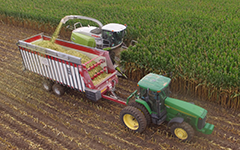
    To begin to create optimum corn silage in bunkers, piles or bags, you must harvest between 65 and 68% whole-plant moisture. Aim for a little less moisture for tower silo storage.

  3. Repair and prep your silos

    Remove all old forage and weeds. Examine and repair silo walls and seal cracks, as even a little air penetration causes costly silage loss. In tower silos, check for rotted doors and seals, make sure staves are sound, check the distributor for proper working order and make sure there are no air leaks.

  4. Schedule a harvest crew meeting

    Make sure everyone involved understands the quality requirements. Chopper settings must deliver desired kernel and plant processing. The packing effort must keep up with harvest tonnage per hour. Forage and packing quality must also be checked throughout harvest.

    Make sure packing tractors are heavy and you have enough of them to keep up. At harvest rates greater than 100 tons/hour, you might need more than one packing tractor.

  5. Review packing practices

    Pack the bunker silo at a recommended density of 15-18 lbs dry matter/cu ft. Check your current corn silage density to see if you have met this goal or if you need to make improvements for this year.

    Match your tractor weight, the time spent packing and the prepacked silage layer thickness (less than 6") to the tonnage delivery rate per hour. Higher-density packed silage gives you more tonnage stored and less dry-matter loss. For example, you can lose 20% dry matter during a six-month feed-out time if your density is 10 lbs/cu ft, but a density of 22 lbs will yield only a 10% loss.

Continue reading tips to help chop and store stellar silage >

Want to use this article? Click here for options!
© 2008 Penton Media Inc.

Research in Brief

The following items report on forage-related research recently presented by University experts at meetings across the country.

Latest Jobs

Browse Back Issues

  • May 2008 Cover
  • April 2007 Cover
  • March 2008 Cover
  • February 2008 Cover
  • January 2008 Cover
  • November 2007 Cover

Resources

  • USDA Hay Prices
  • Horse Fodder
  • Product Info
  • Custom Forage Harvesting
  • Industry Links
  • National Alfalfa Symposium
AgribizJobs.com - find agriculture jobs near you!

Marketplace Ads

  • Hay for Sale

    Hay for Sale/Wanted Listings

  • Your ad Here!

    Advertise your business here! Find out how.

  • Ag Maps for sale

    Ag Maps for Sale!

Back to Top