Close
The author is the managing editor for Hay & Forage Grower.

Jan. 19 2021 The annual release of hay and forage data that defines the previous year’s hay production and year-ending inventories arrived in email inboxes last week. The USDA’s Crop Production and Crop

Jan. 19 2021 In an effort to beef up the productivity of existing pastures, one approach is to broadcast a mixture of fertilizer and seed in the same pass over the field. At the American Forage and Grassland
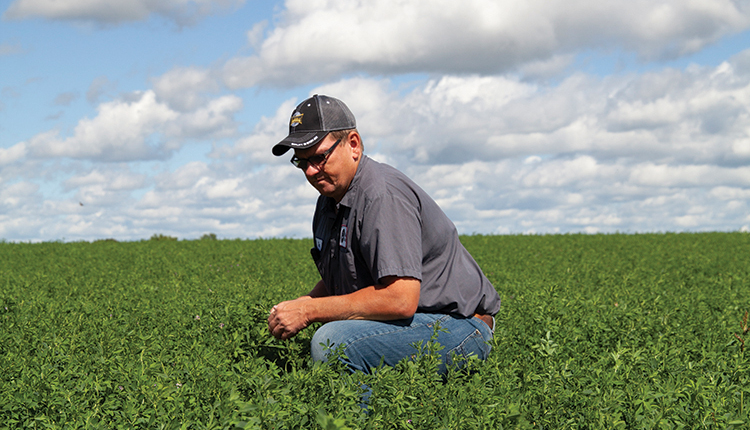
Jan. 12 2021 It's now been five years that alfalfa varieties with the HarvXtra trait have graced the pages of seed company brochures

Jan. 12 2021 Prudent farm managers generally don’t blindly cut expenses during challenging economic times; rather, they look for those places where eliminating costs will have little or no impact on crop yield

Jan. 12 2021 An alfalfa hay sample outdistanced 370 entries to earn grand champion honors in the 2020 Southeastern Hay Contest presented by Massey Ferguson

Jan. 5 2021 Hay markets have been pretty boring for about the past year and a half. That’s not to say there haven’t been events that impacted markets locally or regionally, it’s just that the big...

Jan. 5 2021 There are many reasons why new forage seedings sometimes fail. Too much or too little moisture is always a concern, but moisture is beyond our control unless irrigation is in play

Jan. 5 2021 The average price of U.S. alfalfa hay in November was pegged at $167 per ton, $4 per ton lower than October and $2 per ton below one year ago. The latest USDA Agricultural Prices report pegged other h

Dec. 29 2020 This past year was a roller coaster of highs and lows on so many levels. Just in case reading eHay Weekly wasn’t front and center on your “to do” list every Tuesday morning, here’s...

Dec. 29 2020 Millions of tons of hay now rest in storage. The quality of this hay will range from the near equivalent of cordwood to leafy rocket fuel

Dec. 22 2020 As much as farmers like to complain about the cost of hay equipment, few forage producers don’t enjoy looking at or reading about the equipment needed to get hay and silage into storage. I can tell

Dec. 22 2020 Developing high-performance replacement heifers for any beef cow herd is an important enterprise, but one that is often neglected. Heifers don’t make the operator money until their first calf is...

Dec. 22 2020 At some point every winter or spring, feeding hay to pastured cattle is going to result in the creation of mud. Mud can have a profound impact on animal stress and productivity, according to Jere

Dec. 15 2020 Seeding grass along with alfalfa has always been standard operating procedure in some areas of the U.S., including the Northeast. Although it’s less common to see in other regions, the popularity...

Dec. 15 2020 It’s common knowledge: Headlands look worse and yield lower than the interior sections of most fields because of excessive field traffic, greater pest pressure, and tree lines that block sunlight...

Dec. 8 2020 In checking his list, we have it on good authority that Santa gave forage producers and their crops high marks in 2020.Thinking back about six months ago, we were given the news that May 1 hay invento

Dec. 8 2020 Photo: Jeff Graybill, Penn StateBy definition, cover crops are planted to protect the soil and contribute to improved soil health. However, often these annual forages are also grazed or harvested as l

Dec. 8 2020 The average price of U.S. alfalfa hay held firm at $171 per ton, exactly the same as the September price and $7 per ton lower than one year ago. The latest USDA Agricultural Prices report pegged other

Dec. 1 2020 In the southern Great Plains, wheat is by far the most common annual forage that is utilized by cattle operations. Thousands of winter wheat acres are used as dual-purpose grazing and grain crops or g

Dec. 1 2020 The age-old battle of determining the optimum corn silage hybrid maturity has always been a bit like playing Russian roulette. The higher yields promised by pushing the maturity higher for a give
..
Visit our partner publications:
Hoard's Dairyman | Journal of Nutrient Management